
From Data to Decisions: How AI Is Revolutionizing Process Analysis at aiio

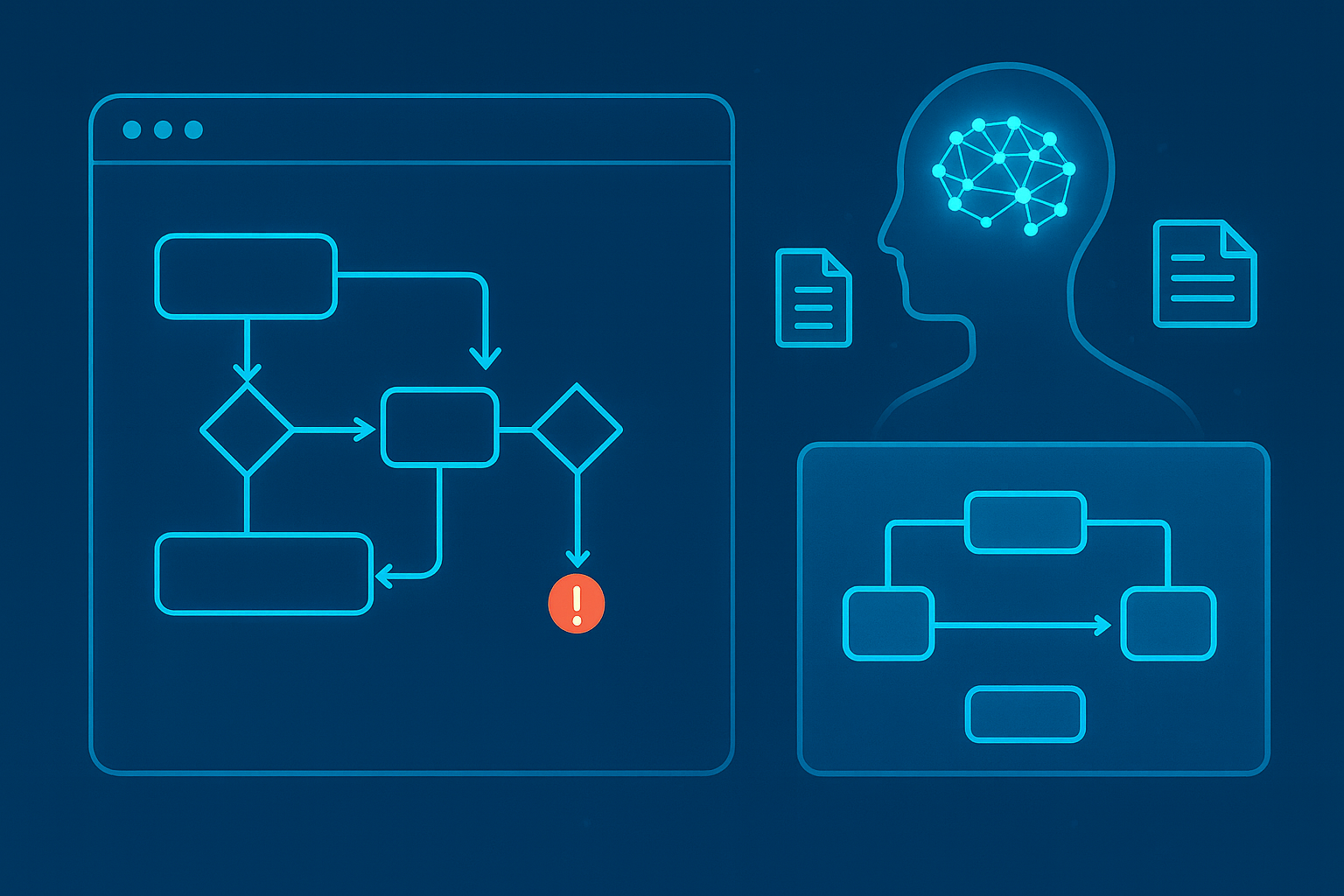
Discover how aiio uses AI to accelerate process analysis, uncover hidden potential, and enable you to make data-driven decisions in seconds.
Every company has process data—but few manage to use it to make quick, informed decisions. Instead of clear answers, there are scattered Excel spreadsheets, isolated reports, and gut feelings in meetings. This is exactly where AI-powered process analysis in aiio comes in: it combines process mining data and expert knowledge into a comprehensive overview that you can analyze in seconds.
aiio uses AI agents to automatically extract processes from documents and IT systems, visualize workflows, and identify opportunities for optimization at the click of a button. In this article, you’ll learn how this AI works, what decisions it supports in day-to-day operations, and why it’s a game-changer—especially for process intelligence champions and operations managers.
What aiio means by AI-powered process analysis
aiio takes an " Agentic Process Intelligence" approach : AI agents gather process knowledge from unstructured sources such as documents, emails, or Confluence and combine it with event data from workflow tools.
This results in a process view that goes far beyond traditional process mining: it takes into account not only “What happens in the system?” but also “How was the process actually intended?”
- The import agent extracts process knowledge from documents and creates BPMN-compliant models in minutes.
- The optimization agent analyzes these models and shows you specific improvement options along with their estimated potential.
From Document Chaos to an Analyzable Process
Automatic AI import instead of manual modeling
In many organizations, process knowledge is stored in Word files, PowerPoint presentations, or SharePoint folders. aiio uses AI to read this content, identify workflows, and generate structured process models directly from it.
Instead of spending weeks on workshops and modeling, you can create an initial process map in just a few minutes—one that you can analyze right away. According to aiio, this allows processes to be documented up to four times faster than with traditional BPM tools.
Understanding the context rather than just counting click paths
The AI in aiio not only identifies steps, but also roles, decisions, and dependencies. This makes the subsequent analysis much more meaningful:
- Where do decision-making bottlenecks occur?
- Which role is overloaded?
- Which loops keep coming up?
This makes it clear to operations managers in particular where organizational—rather than merely technical—problems lie.
How the AI optimization agent prepares decisions
Seconds instead of weeks: Results at the click of a button
The AI Optimization Agent in aiio automatically analyzes processes and provides actionable recommendations.
Some typical suggestions include, for example:
- Combining redundant steps
- Moving tests to more efficient process steps
- Removing unnecessary loops or duplicate approvals
For each suggestion, the AI shows how many steps, how much time, or how many hand-offs are expected to be saved as a result
Real-world example: Optimizing invoice approval with AI
Previously:
- 12 process steps
- 8-day turnaround time
- 5 transfers between departments
- 3 manual test loops
AI analysis identifies:
- 2 redundant approval levels
- 1 unnecessary return loop
- Inefficient order of the exams
Later:
- 7 steps
- 3-day turnaround time
- 3 handovers
- Savings: 62% faster, 40% less effort
From Potential to Priority
Instead of simply listing “nice-to-have” improvements, aiio prioritizes optimization suggestions based on their impact. The AI assesses which changes have the greatest impact on turnaround time or complexity.
As a Process Intelligence Champion, you can decide during a session which actions to implement first—without having to set up complex analyses yourself.
Human oversight: Human-in-the-loop instead of a black box
aiio believes it's important for AI to make recommendations, but you make the final decision. Every optimization option is transparent and easy to understand:
- The original process path remains visible.
- The AI highlights which elements would be affected.
- You can accept, modify, or reject suggestions.
This human-in-the-loop principle ensures that teams experience AI as a competent co-pilot—not as an opaque autopilot.
Why AI in aiio is more than just an “add-on”
Many BPM tools now include AI capabilities in their product portfolios, often as standalone features. aiio, on the other hand, builds AI into the core of its process intelligence platform: from import and modeling to optimization.
Current market trends show that AI-powered process intelligence solutions are increasingly in demand because they deliver transparency, speed, and high-quality decision-making all in one.
aiio explicitly positions itself here as a “Process Forge,” where data, knowledge, and AI converge in a single workspace.
Best Practices: How to Get the Most Out of AI in aiio
- Start with real-world processes: Choose a specific, relevant process (e.g., quote approval) for the first AI import.
- Integrate data sources properly: Use consistent documents whenever possible and, where feasible, event data from your systems.
- Evaluate AI suggestions collaboratively: Involve departments in the evaluation of optimization suggestions—this increases acceptance and the implementation rate.
- Take an iterative approach: After making initial adjustments, analyze the results again and use the AI for the next improvement cycle.
From Process Knowledge to Better Decisions
aiio demonstrates how AI-powered process analysis radically shortens the path from data to decisions. Knowledge from documents, systems, and teams is automatically integrated into processes, evaluated by AI, and accompanied by concrete recommendations for action.
For Process Intelligence champions, this means less time spent searching for data and more time dedicated to actual control. For operations managers, it means clear opportunities on the table instead of abstract “optimization initiatives.” And for the company as a whole, it means a process landscape that is not only documented but actively refined.
Don't hesitate, ask directly
Please use our contact form. Our team will get back to you as soon as possible.


Further contributions
More about aiio, process management, and the world of AI.

Process Management Software for Small Businesses: Start Small, Scale Smartly

What Features Modern Process Management Software Must Have Today (Including AI)
