
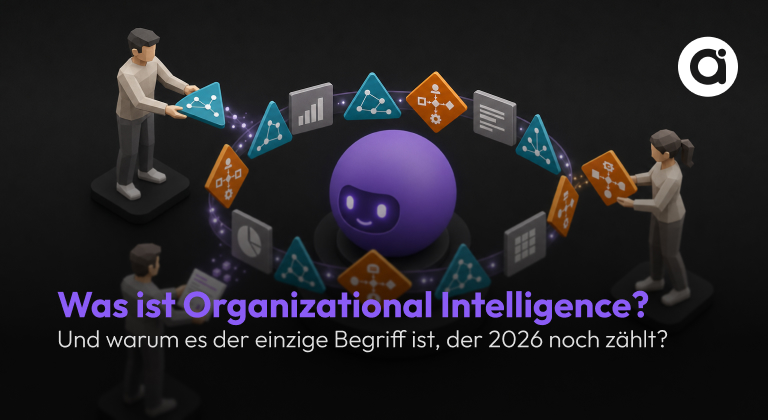
What is Organizational Intelligence? And why is it the only term that will still matter in 2026?
.jpeg)
Your business is up and running. You just don't know exactly how.
Imagine you have 200 employees. Every day, decisions are made, tasks are delegated, and processes run their course... some go well, some go poorly, and most just sort of get by. When an experienced colleague leaves the company, their knowledge goes with them. If you want to introduce a new process, you ask three different people and get four different answers.
You know something is missing. You might call it "transparency," "documentation," or "knowledge management." What you really mean is: Organizational Intelligence.
This term is popping up everywhere right now. And yet, hardly anyone explains it in a way that’s actually useful. We’re going to change that here.
What Organizational Intelligence (OI) Really Means: An Honest Definition
Organizational intelligence is a company’s ability to understand, learn from, and act upon its own processes, decision-making structures, and knowledge base in real time, without the need for human intervention.
That sounds abstract. Let's make it more concrete.
Here’s how a company without organizational intelligence operates: When the sales team wants to know how a new product is rolled out, they ask someone from the operations team. That person explains it based on their own understanding—that is, drawing on the experiences of the past three years, the shortcuts they’ve personally developed, and the blind spots of the past six months.
Here’s how a company with organizational intelligence works: The sales team asks a question—to a system, an agent, or a dashboard. The answer is up-to-date, complete, and the same for everyone. It’s based on what’s actually happening—not on what someone remembers.
Organizational intelligence is your company’s operating system. Except that most companies are still running on Post-its and the grapevine.
Why BPM doesn't solve the problem. And sometimes makes it worse
At this point, we need to talk about the term that comes up in every other conversation as soon as the topic turns to processes: Business Process Management. Or, for short: BPM.
BPM isn't wrong. But BPM isn't the answer to the question of organizational intelligence either, and this is the difference that, in practice, can mean millions of euros.
Classic BPM works like this:
- A consultant or an internal process team documents the processes
- These are documented in models—BPMN diagrams, swimlane charts, and process maps
- The documentation is approved, communicated, and entered into a tool
- Six months later, no one remembers if that’s still true
The result: processes exist in the system. In the company itself, things work differently.
That's not an implementation problem. It's a paradigm problem.
BPM models processes for people: as documentation, as proof of compliance, and as training materials. The average employee should be familiar with the processes, understand them, and follow them.
Organizational Intelligence models processes for machines: as structured knowledge that AI systems, automation tools, and analytics tools can actively utilize. The average employee doesn’t see any of this. They simply notice that their work runs more smoothly.
That is the fundamental difference.
The Three Dimensions of Organizational Intelligence
If you want to build organizational intelligence, you need three things. In this order:
1. Process knowledge: What actually happens (not what is documented)
The first step is to take an honest look at reality—not as processes are described in the manual, but as they actually unfold, including the exceptions, workarounds, and variations that arise depending on the team, location, or time of day.
That sounds like a huge undertaking. Modern systems can capture this data automatically in a matter of hours—through process mining, AI-assisted interviews, and the analysis of system data. What used to be a three-month project can now be completed in a matter of days.
2. Knowledge Structure: A knowledge graph instead of a drawer full of diagrams
Raw process data is worthless unless it is structured. The key difference between a traditional process model and a knowledge graph is as follows:
A process model shows what happens. Step by step, linearly, statically.
A knowledge graph shows how everything is connected. What roles are involved? What systems are used? What decisions are made? What happens if step 3 fails? How does this process compare to processes in other teams?
Imagine the difference between a road map from 2010 and real-time Google Maps. Both show you the way. But only one adapts, learns, and gets better over time.
3. Activation: Process knowledge that is actually put to use
The third—and crucial—step: activating structured knowledge.
In concrete terms, this means:
- AI agents gain context about business processes and can make informed decisions
- Automation systems are becoming more precise because they know what exceptions exist and how to handle them
- Analytics dashboards don't just show numbers; they explain why things happen
- New employees get up to speed in days rather than weeks. That’s because the knowledge isn’t stored in their colleagues’ heads, but in the system
Organizational intelligence is achieved when your company learns from itself: continuously, without anyone having to actively document a process.
Organizational Intelligence in Practice: A Concrete Example
A medium-sized company with 150 employees in the manufacturing sector. Three locations. The problem: Each location has developed its own way of handling complaints. The sales team makes inconsistent promises. The operations team is frustrated. The CEO lacks transparency.
The classic answer: a BPM project. Three months of analysis, a standardized process, training, and rollout. Cost: high. Acceptance: moderate. Sustainability: questionable.
The OI approach:
Week 1: Automatic process recording at all three locations. No consultants. No workshops. The system learns how complaints are actually handled—in all their variations.
Week 2: The knowledge graph has been built. The CEO sees for the first time how the three versions differ and which one produces the best results.
Weeks 3–4: The best process is established as the standard. An AI assistant provides the sales team with real-time guidance on which promises are feasible. New employees are automatically onboarded.
Week 6: First measurable results. Processing time is decreasing. Customer satisfaction is increasing. And more importantly, the system continues to learn.
Not a project that is completed and then becomes obsolete. A living system that grows with the company.
Why Organizational Intelligence Matters Now, Not in Three Years
There’s a reason why this term is suddenly popping up everywhere in 2026: Enterprise AI only works with structured context.
Every company currently planning AI initiatives will sooner or later run into the same problem: The models are good, yet the results are disappointing. Why?
Because an AI agent is only as good as the knowledge it is fed. And this knowledge—who makes which decisions, how processes work, and what exceptions exist—is not systematically documented anywhere in most companies.
Organizational intelligence is the missing foundation for enterprise AI.
Without it, you're investing in AI systems that operate based on assumptions. With it, you're investing in AI systems that truly understand your business.
The companies that are building this today will have a structural competitive advantage in 18 months. Not because their AI models are better, but because their AI models know more.
How to Build Organizational Intelligence. Without an 18-Month Project
The biggest hurdle for most decision-makers is the fear that "This is just another major project. We don't have the budget, the time, or the energy for it."
The opposite is the point.
Organizational Intelligence is not a project that will ever be finished. It is an ongoing process that, however , delivers value from day one. The question is not, “Do we have the resources for an OI project?” The question is, “When do we want to start learning from our own organization?”
The process consists of three phases:
Phase 1: Capture (Weeks 1–2): Automatic recording of the current reality. No workshop. No modeling project. The system learns how things really work.
Phase 2: Structuring (Weeks 3–4): Building the knowledge graph. Connections between processes, roles, systems, and decisions become apparent.
Phase 3: Activation (starting in Week 5): The structured knowledge is made available for use by AI systems, automation tools, and analytics. The first business results become measurable.
Not by the quarter. By the week.
The Most Common Misconceptions About Organizational Intelligence
"That's just BPM under a different name."No. BPM documents for people. OI structures for machines. BPM is a one-time project. OI is a continuously learning layer. BPM produces diagrams. OI produces operational intelligence.
"We won't need that until we're bigger."Organizational intelligence becomes more valuable as a company grows. But the right time to build it is before complexity becomes unmanageable. Those who build it now scale alongside it. Those who wait end up building it under pressure.
"We built this using ChatGPT. It’sfine for the first four weeks. But who’s going to maintain it in 12 months? How does it scale to 200 processes? How will you explain to the compliance team what data your AI agents are basing their decisions on? Organizational intelligence requires governance, structure, and integration. This isn’t a criticism of GPT; it’s a different challenge."
What now?
Organizational intelligence isn't just a buzzword. It's the answer to a question that every growing company asks sooner or later: "How do we ensure that our company learns from its own experiences—and that this knowledge isn't locked away in the minds of individual employees?"
The answer was simple: expensive consultants, long-running projects, and unsatisfactory results.
Today she's different.
Find out where your business stands today in a free 30-minute assessment with our team →
This article was written by the aiio team. aiio is the Organizational Intelligence platform for companies that have stopped believing that BPM projects are the answer.

Don't hesitate, ask directly
Please use our contact form. Our team will get back to you as soon as possible.


Further contributions
More about aiio, process management, and the world of AI.

Process Management Software for Small Businesses: Start Small, Scale Smartly

What Features Modern Process Management Software Must Have Today (Including AI)
